

Leveraging the transformational potential of
high-end & advanced technologies
A Data Driven Forest Intelligence
Login here
ECOLOGY SIMULATOR FOR PRECISION BIODIVERSITY
The Ecological Simulator System is a decision-making support system that turns forest biodiversity data into visual insights and interactive simulations.
It is designed to investigate the biodiversity responses and implications of various forest management options.
The Goal of the Ecology Simulator
The Ecology Simulator for Precision Biodiversity helps stakeholders to understand forest biodiversity dynamics, explore better conservation planning and harvesting options for sustainable forest management.

Insightful visuals
To help users identify patterns and trends in biodiversity.

User understanding
To enhance comprehension of biodiversity changes over time.

Interactive simulations
Enable users to project the possible future effects of different harvesting and conservation options.
Features of the Ecology Simulator
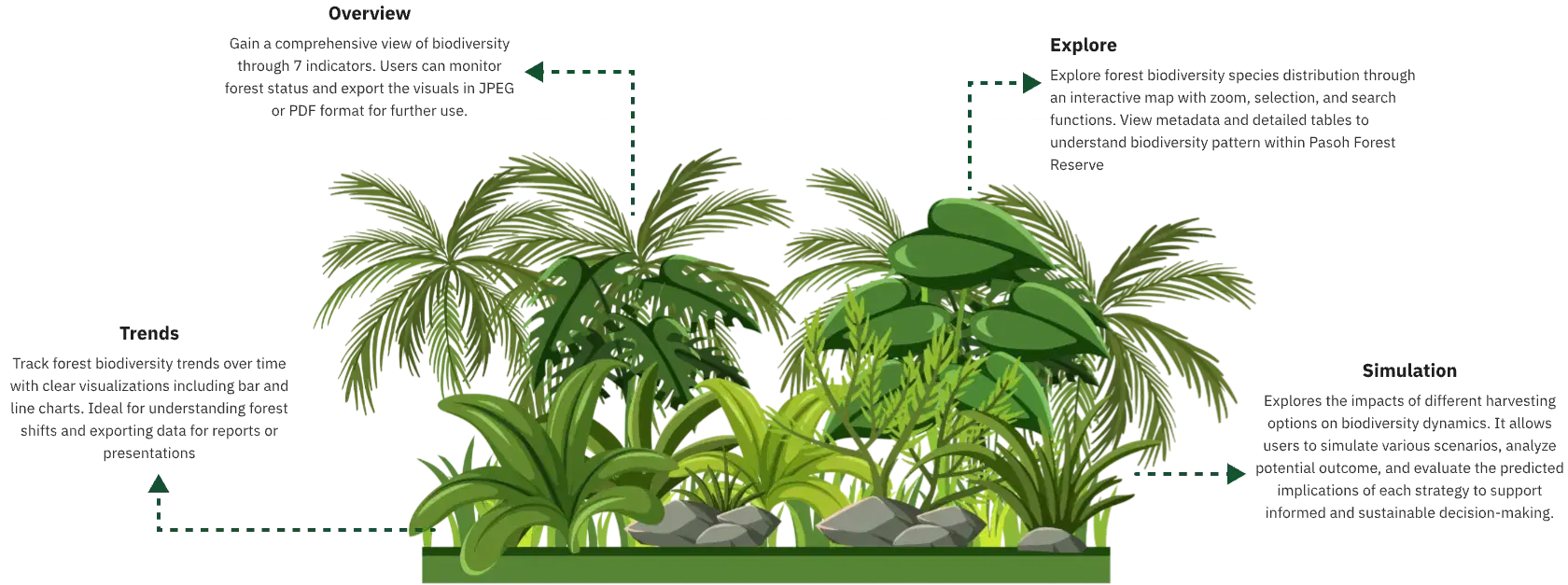
The Ecology Simulator is a decision-support tool designed to facilitate biodiversity management. It enables detailed exploration, monitoring, and analysis through four key functional areas
How does the system help users understand biodiversity patterns and trends?
The system provides insightful and interactive visualizations that enable users to identify patterns and trends in biodiversity. These data-driven insights support strategic decision-making and enable near real-time risk assessment for forest ecosystems.
How does the platform improve understanding of biodiversity changes over time?
Users gain a clearer understanding of temporal changes in biodiversity, supporting effective monitoring and adaptive forest management. The platform's ability to detect and profile new plant and animal species further enhances ecological research and biodiversity discovery.
Can the system simulate different forest management strategies?
Yes. The system enables users to simulate multiple forest management and conservation scenarios, allowing comparison of different strategies and their potential ecological impacts. This supports informed decision-making and promotes the sustainable use of forest resources.
How does the simulator support the planning of harvesting scenarios and generate projections of future forest conditions?
The simulator allows users to design and compare harvesting scenarios using both automatic and manual selection methods. Trees can be selected individually or directly on the interactive map. The system then generates projections of future forest structure and biodiversity dynamics, supporting long-term, sustainable forest management planning.
Who benefits from using the Ecology Simulator?
The Ecology Simulator benefits a wide range of users, including scientists, forest managers, conservation practitioners, and policy stakeholders. It supports biodiversity monitoring, risk identification, and optimization of management practices, while enhancing communication through clear, exportable data visualizations.
What technologies power the Ecology Simulator, and how do they contribute to conservation?
The Ecology Simulator is powered by a combination of geospatial technologies (GIS), ecological modeling, data analytics, and interactive visualization tools. These technologies enable accurate spatial analysis, predictive simulations, and scenario-based assessments of biodiversity outcomes. By integrating scientific data with user-friendly interfaces, the system supports evidence-based conservation planning, improves transparency, and strengthens collaboration among stakeholders.
| Modules | Manager, Botanist, and Researcher |
|---|---|
| Biodiversity Dynamics Assessment | Quickly evaluate forest conditions through metrics calculation, trend analysis, and species mapping for informed decision-making. |
| Biodiversity Dynamics Simulation | Simulate harvesting scenarios and ecological impacts to visualize changes in forest composition over time. |
| Biodiversity Dynamics Environment | Monitor real-time forest conditions and explore the environment with IoT data and interactive 360° views. |
| Data Exports and Reports | Easily generate and export comprehensive reports in multiple formats for biodiversity assessments and system monitoring |
References:
- A Selective Management System (SMS): A case study in the implementation of SMS in managing the dipterocarp forests of Peninsular Malaysia. Kyushu Journal of Forest Sciences, 57, 39-44. Pakhriazad, H. Z., Shinohara, T., Nakama, Y., & Yukutake, K. (2004).
- Standard kualiti air kebangsaan dan indeks kualiti air. Department of Environment Malaysia. (2025). Click Here
- National water quality standards for Malaysia. Department of Environment Malaysia. (2021). Click Here
- Microclimate in Forest Ecosystem and Landscape Ecology. BioScience, 49(4), 288–297. Chen, J., Saunders, S. C., Crow, T. R., Naiman, R. J., Brosofske, K. D., Mroz, G. D., Brookshire, B. L., & Franklin, J. F. (1999). Click Here
- The effect of forest fragmentation on microclimate condition at forest edges in Pulau Pangkor, Perak, Peninsular Malaysia. Malaysian Forester, 82(1), 11–16. Majid, S., & Sulaiman, M. S. (2019). Click Here
- Beaufort wind scale table. Aem. Canada, E. and C. C. (2011, February 11). Click Here
- Standard Baru Kualiti Udara Ambien Malaysia. Baru, S., Udara, K., Disediakan, A., Panduan, G., & Malaysia, A. (n.d.). Click Here
- UV Index Scale | US EPA. US EPA. US EPA,OAR. (2019, May 24). Click Here
- Global critical soil moisture thresholds of plant water stress. Nature Communications, 15(1). Fu, Z., Philippe Ciais, Jean-Pierre Wigneron, Gentine, P., Feldman, A. F., Makowski, D., Viovy, N., Kemanian, A. R., Goll, D. S., Stoy, P. C., Iain Colin Prentice, Yakir, D., Liu, L., Ma, H., Li, X., Huang, Y., Yu, K., Zhu, P., Li, X., & Zhu, Z. (2024). Click Here
- The Effects of Soil Temperature on Plant Growth, Nodulation and Nitrogen Fixation in Casuarina cunninghamiana Miq. The New Phytologist, 101(3), 441–450. Reddell, P., Bowen, G. D., & Robson, A. D. (1985). Click Here
- ASEAN soil and nutrient management guidelines. Association of Southeast Asian Nations. (2021). Click Here
- Soil Quality Indicators Soil Electrical Conductivity. USDA Natural Resources Conservation Service. USDA . (2011). Click Here